Find water where the last driller found none.
WaterLocation pinpoints water-bearing fractures before a rig arrives: the drilling point, the depth and the expected yield. You pay our discovery fee only after a pumping test confirms the water.
Field work takes 2–3 days. You get a report with coordinates, depth and forecast yield.
11 projects since 2016 in Saudi Arabia, Namibia, South Africa, Sierra Leone, Turkey, Germany, Spain and Latvia, most of them on sites where earlier drilling had failed.
- Depth to water
- 22 m
- Yield
- 200 m³/day
- Before us
- 4 dry boreholes, up to 118 m
A dry borehole is paid for in full.
Drillers are paid by the metre, whether water comes up or not.
On hard sites (granite, basalt, desert, deep clay) conventional surveys look for aquifers that often aren't there. Owners end up with a field of empty holes and no answer about where to drill next.
What have dry holes cost you so far?
Spent on boreholes that didn't deliver
$45,000
Before pumps, casing, permits and months of delay.
How a survey works
- 01
Agreement and water demand
We sign the survey agreement, calculate how much water you need per day and check how it will reach the point of use.
- 02
Field measurement
Our specialists record seismic and resonance signals across the site. Usually 2–3 days on the ground.
- 03
Lab analysis and report
The data is interpreted in the lab. You receive the drilling point coordinates, the depth and the forecast yield.
- 04
Drilling
A licensed local driller works to our specification: air-flush rig, 300 mm diameter, casing plan for saline layers.
- 05
Pumping test
When the water-bearing zone is reached, yield is measured with a pump and compared with the forecast.
- 06
Payment and fit-out
The discovery fee is due once the source is confirmed. The well is then equipped to our requirements.
You contract the driller and obtain drilling permits directly. We set the point and depth, and attend the pumping test.
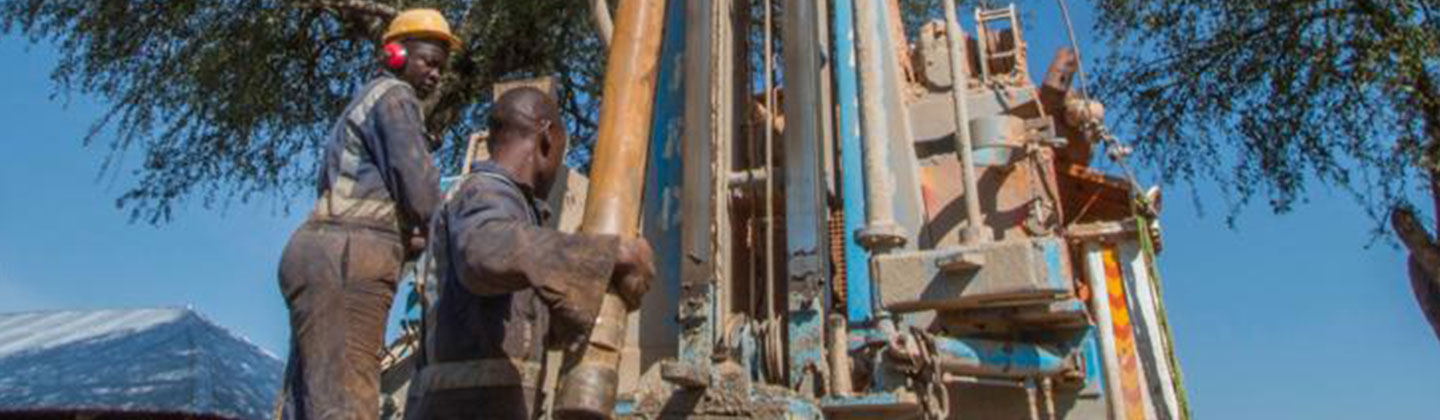
No water, no discovery fee.
Water exploration is a risky business, so we carry the risk. If a borehole drilled at our point and to our depth doesn't deliver water, you don't pay for the discovery.
The drilling contractor is paid separately under your agreement with them. Exact terms are set in the survey agreement.
Request a site surveyHow we find water in rock
Most groundwater surveys look for aquifers: layers of sand or gravel that hold water. In granite, basalt, dolomite and under deep clay those layers are often missing, so the surveys come back negative.
We look for something else: fractures in the rock that carry pressurised water. The method is related to hammer seismic surveying, but in addition to the echo we record the resonant response of the ground. Software interprets both and shows where a fracture runs, how deep it lies and how much water it can give.
The system was built by geophysicists and software engineers and has been used on real sites since 2016.
What your driller will need
- An air-flush rig. If drilling fluid is unavoidable, cellulose-based only.
- Capacity to drill past 200 m through clay or saline layers.
- Selective casing or packers where salt water is present.
- Airlift or mud-pump flushing, then a flow test.
Projects
Each of these started with a negative forecast or failed boreholes.
Oct 2024
Spain
Before. Several boreholes on the site had failed. A driller with 40 years of experience concluded there was no water here.
Result. Water came in right below the clay, at 136 m. Static level 39 m below ground. The official state pumping test confirmed 648 m³ per day.
- Well depth
- 200 m
- Water from
- 136 m
- Yield
- 648 m³/day
Jun 2023
Latvia
Before. Many dry boreholes in the area. Village wells give enough water only after good rainfall, and the quality is poor.
Result. A 63 m borehole through 50 m of dolomite and 10 m of clay into sandstone. The well is artesian: water rises 4 m above ground and flows at about 200 m³ per day without a pump.
- Well depth
- 63 m
- Water from
- 60 m
- Yield
- 200 m³/day
Apr 2023
South Africa
Before. 25 boreholes already on the site. Only four gave a steady flow, and together they didn't cover demand.
Result. A 150 m borehole with a static level of 28 m, giving about 200 m³ per day.
- Well depth
- 150 m
- Yield
- 200 m³/day
Dec 2022
Namibia
Before. Nine wells on the site. Two gave water only in the rainy season, one gave it all year but not enough.
Result. Two new wells. The first, 240 m deep, reached water at 57 m and gives 100 m³ per day. The second, 132 m deep, reached water at 21 m and gives more than 350 m³ per day.
- Well depth
- 132 m
- Water from
- 21 m
- Yield
- 450 m³/day
- Two wells: 100 and 350+ m³/day
Jun 2020
Germany
Before. Forecasts said a large source was impossible here. The farm needed 10 litres per second; an earlier 80 m borehole gave 2.
Result. Water at 88 m with a static level of 56 m, at the required 10 litres per second.
- Well depth
- 88 m
- Yield
- 864 m³/day
- 10 litres per second
May 2020
South Africa
Before. Geologists and local drillers said any water here would be salty. Six earlier attempts: five dry boreholes and one with very salty water.
Result. Fresh water on both farms: at 14 m giving 86 m³ per day, and at 97 m giving 260 m³ per day.
- Well depth
- 97 m
- Yield
- 346 m³/day
- Two wells: 86 and 260 m³/day
Apr 2019
Germany
Before. Every previous borehole failed. Geologists recommended connecting to the central network, a long and expensive project.
Result. Water found on the hilltop, 15 m from the collector. About 200 m deep, static level 87 m. Demand was 260 m³ per day; the well gives more than 300.
- Well depth
- 200 m
- Yield
- 300 m³/day
Mar 2018
Saudi Arabia
Before. Geological forecasts were negative, the driller didn't expect any water, and the client was about to stop searching.
Result. First artesian water at 43 m, as forecast. The main source at 150 m gives 1,000 m³ per day.
- Well depth
- 150 m
- Water from
- 43 m
- Yield
- 1,000 m³/day
Nov 2016
Germany
Before. The previous contractor left four empty boreholes up to 118 m deep. Other drilling companies gave negative forecasts.
Result. Water at 22 m, 47 m away from one of the empty boreholes, with a steady 200 m³ per day.
- Well depth
- 22 m
- Yield
- 200 m³/day
Undated
Sierra Leone
Before. Plenty of rain in the wet season but not enough storage, so the city went three months a year without water. Standard boreholes gave very little.
Result. First water at 20 m. At the current depth of 60 m the borehole gives 250 m³ per day. Next drilling stages are under discussion.
- Well depth
- 60 m
- Water from
- 20 m
- Yield
- 250 m³/day
Undated
Turkey
Before. Several boreholes within 1 km gave 1 to 4 litres per second, or nothing at all.
Result. The clay was drilled through at 360 m and the water-bearing zone was reached at 410 m, as forecast. Reported capacity: more than 10,000 m³ per day.
- Well depth
- 410 m
- Yield
- 10,000 m³/day
Who we work with
Farms and agriculture
Steady water for irrigation and livestock where wells dry out in summer or turn salty.
Discuss your projectDevelopers, hotels and resorts
Your own water source for projects far from the network, sized to demand before construction starts.
Discuss your projectMunicipalities and governments
Supply for towns and villages where rain storage runs out in the dry season.
Discuss your projectMining and industry
Process water in arid regions without trucking it in or building desalination.
Discuss your projectQuestions
What does a survey cost?
It depends on the site, the area to cover and how much water you need. We send a quote after the first call. The discovery fee is paid only after water is confirmed.
Do you drill the well?
No. A licensed local contractor drills to our point, depth and specification, and we attend the pumping test. We can recommend drillers we have worked with.
How deep will we have to drill?
Usually less than 200 m. With thick clay or saline layers it can be deeper. The report gives the depth before drilling starts.
We already have dry boreholes. Can you still help?
That's the most common starting point. Send the logs of existing boreholes with your request; they help the analysis.
Which countries do you work in?
The Gulf, Africa and Europe. Past projects include Saudi Arabia, Namibia, South Africa, Sierra Leone, Turkey, Germany, Spain and Latvia.
Will the water be drinkable?
Quality depends on the site and is confirmed by a lab test after drilling. In our projects the water has typically been fresh, including on sites where nearby wells were salty.
Request a site survey
Tell us about the site and what you need the water for. We'll reply by email or WhatsApp with next steps and a quote.
or write to hello@waterlocation.com